A 200-SKU catalog shoot at a New York jewelry studio runs $5,000 to $20,000 and takes 2 to 4 weeks including shipping and revisions. The same catalog through AI vs traditional jewelry photography workflows on NeuroViz finishes in an afternoon and costs roughly $300 in credits — about 70× cheaper.
That’s a real number, not marketing math. But it’s also not the whole story. Traditional studio photography still owns hero campaigns, luxury editorials, and a few categories where AI still slips. This guide gives you the honest cost, speed, and quality comparison across six axes — so you can decide which path (or which mix) fits your line.
We’ve processed 1M+ jewelry images for 500+ businesses since launch. That data shapes every number below.
TL;DR — Key Takeaways
- Cost per image: Traditional studio runs $25–$100/image (sometimes $200+ for hero shots). AI jewelry photography runs $0.09–$3.20/image with NeuroViz, with a typical ~$0.50/image at the $200 pay-as-you-go rate — easily 90%+ cheaper at catalog scale.
- Speed: Studio takes half a day to several days per SKU including shipping and revisions. AI returns a finished image in ~30 seconds.
- Quality: AI now matches studio output for catalog, marketplace, and social images on most jewelry. Studio still wins on hero campaigns, complex multi-stone pieces, and editorial brand shoots.
- Scale: Studio doesn’t scale linearly — 1,000 SKUs is a project. AI cost scales linearly and finishes the same day.
- Skill: Studio needs a photographer, a retoucher, and a stylist. AI needs a product photo and a credit pack.
When to use which: AI for volume catalogs, marketplaces, A/B variants, lifestyle and try-on. Studio for hero brand shots, awards, magazine work, and ultra-high-end stones.
For volume catalogs specifically, the production side — batch, team accounts and API — is covered on the For Business page.
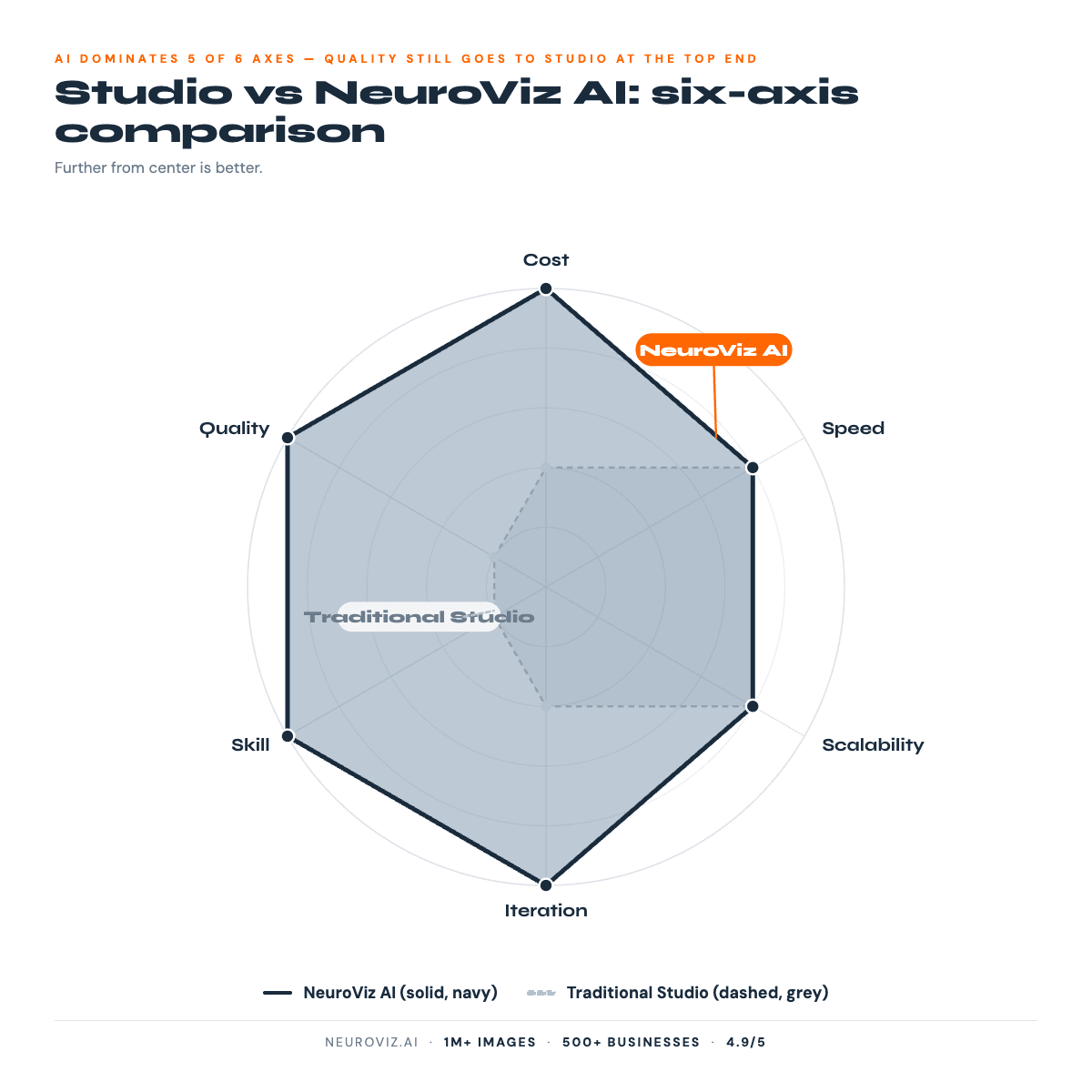
Six-axis radar chart comparing Traditional Studio vs NeuroViz AI across Cost, Speed, Quality, Scalability, Iteration, and Skill — AI dominates everywhere except the high end of Quality
How Much Does Jewelry Photography Cost in 2026?
Current payment options: choose pay-as-you-go credits or a subscription with Pro Membership included.
- Pay as you go: $10–$1,000 per purchase. Optional Pro Membership is $29/month with no credits included.
- Monthly subscriptions: Studio $200/month for 10,000 credits, Business $500/month for 30,000, or Scale $1,000/month for 66,000. Pro included.
- Annual subscriptions: $2,000 / $5,000 / $10,000 paid upfront for 120,000 / 360,000 / 792,000 credits per year, respectively. Pro included.
Monthly allowance resets at renewal. Annual credits arrive upfront and stay valid until annual renewal. Separately purchased credits are not part of that expiring allowance. See current pricing.
Pricing breaks into three tiers, and most jewelry brands need a clear answer to how much does jewelry photography cost before they can plan a catalog.
Traditional studio — $25 to $100+ per image
- Mid-tier US/EU jewelry studio: $25–$50/image on a 50+ image bulk rate.
- Boutique studio with retouching included: $50–$100/image.
- Hero / editorial / campaign work: $150–$500+/image plus day rates.
- Add shipping insurance, return shipping, and 1–2 weeks turnaround minimum.
DIY (phone + light tent + Photoshop) — ~$3–$8 per image effective cost
- ~$200 light tent + ~$50/month editing software, amortized.
- Real cost is time: 15–30 minutes per piece including retouching. At a $25/hr opportunity cost, you’re at $6+/image and the result still isn’t catalog-grade unless you’re skilled.
AI jewelry photography — $0.09 to $3.20 per image (typical ~$0.50)
NeuroViz pricing is credit-based, and your per-image cost depends on two things: how many credits the operation consumes (5–80 credits per image, depending on quality and resolution) and which credit pack you buy ($0.018 to $0.04 per credit).
Worked examples at typical 20-credit operations (retouch, try-on, creative photo):
- At $10 volume (250 credits → $0.04/credit) — about $0.80/image. Good for first 4–10 SKUs.
- At $200 volume (8,000 credits → $0.025/credit) — about $0.50/image. A pay-as-you-go example for active sellers.
- At $1,000 volume (55,555 credits → $0.018/credit) — about $0.36/image, a pay-as-you-go option for catalog teams running thousands of SKUs/month.
For lighter operations (5–10 credits — basic retouch) prices drop as low as $0.09–$0.18/image. For hero-grade, max-resolution outputs (40–80 credits) prices reach $1.40–$3.20/image. Video credit costs vary by tool, duration and resolution; check the quote before generating.
- Free trial: 80 credits, no credit card — enough to test the platform on 4–16 of your products before paying anything.
- Compare pay-as-you-go and subscriptions on the NeuroViz pricing page.
That’s the ai jewelry photography cost anchor. Even at the high end of AI ($3.20) and the low end of studio ($25), AI is ~8× cheaper. At typical rates ($0.50 vs $35) it’s 70× cheaper — 98.6% savings.
| Method | Example cost per finished image | Basis |
|---|---|---|
| Traditional studio | $25–$100 | Illustrative production costs discussed in this article |
| DIY photography and editing | $3–$8 | Illustrative cost including your time |
| NeuroViz · pay as you go | $0.50 | A 20-credit generation at the $200 purchase rate ($0.025/credit) |
| NeuroViz · Studio monthly | $0.40 | A 20-credit generation at $0.02/credit; $200/month includes 10,000 credits and Pro |
These are examples, not a fixed per-image price. NeuroViz credit costs vary by tool, settings and resolution; your payment option sets the dollar rate. Compare current pay-as-you-go and subscription pricing.
Speed: 30 Seconds vs Half a Day
Studio days have unavoidable overhead — packing and shipping pieces, setup, lighting calibration, multiple angles per SKU, post-production, revision rounds. Even with a streamlined studio, plan on 0.5–2 days per SKU including ship-in and ship-back.
NeuroViz turnaround:
- Single image: ~30 seconds from upload to download.
- Batch of 100 images: runs in the background and finishes in under an hour on Pro Membership or any current subscription.
- Full catalog (200 SKUs, multiple angles, retouched + on-model + video): one afternoon, end to end.
That speed unlocks behaviors traditional studios can’t price — same-day relisting, weekend marketplace drops, real-time A/B testing of different backgrounds and angles, and refreshing tired listings without booking a shoot. The AI image workflow automation feature chains apps together so you can run retouch → on-model → video as a single click.
Quality: Where AI Has Caught Up — and Where It Hasn’t
This is where most comparison articles cheat. The honest answer: AI quality has caught up for ~80% of jewelry photography use cases. The remaining 20% is real and worth understanding.
Where AI now matches or beats studio
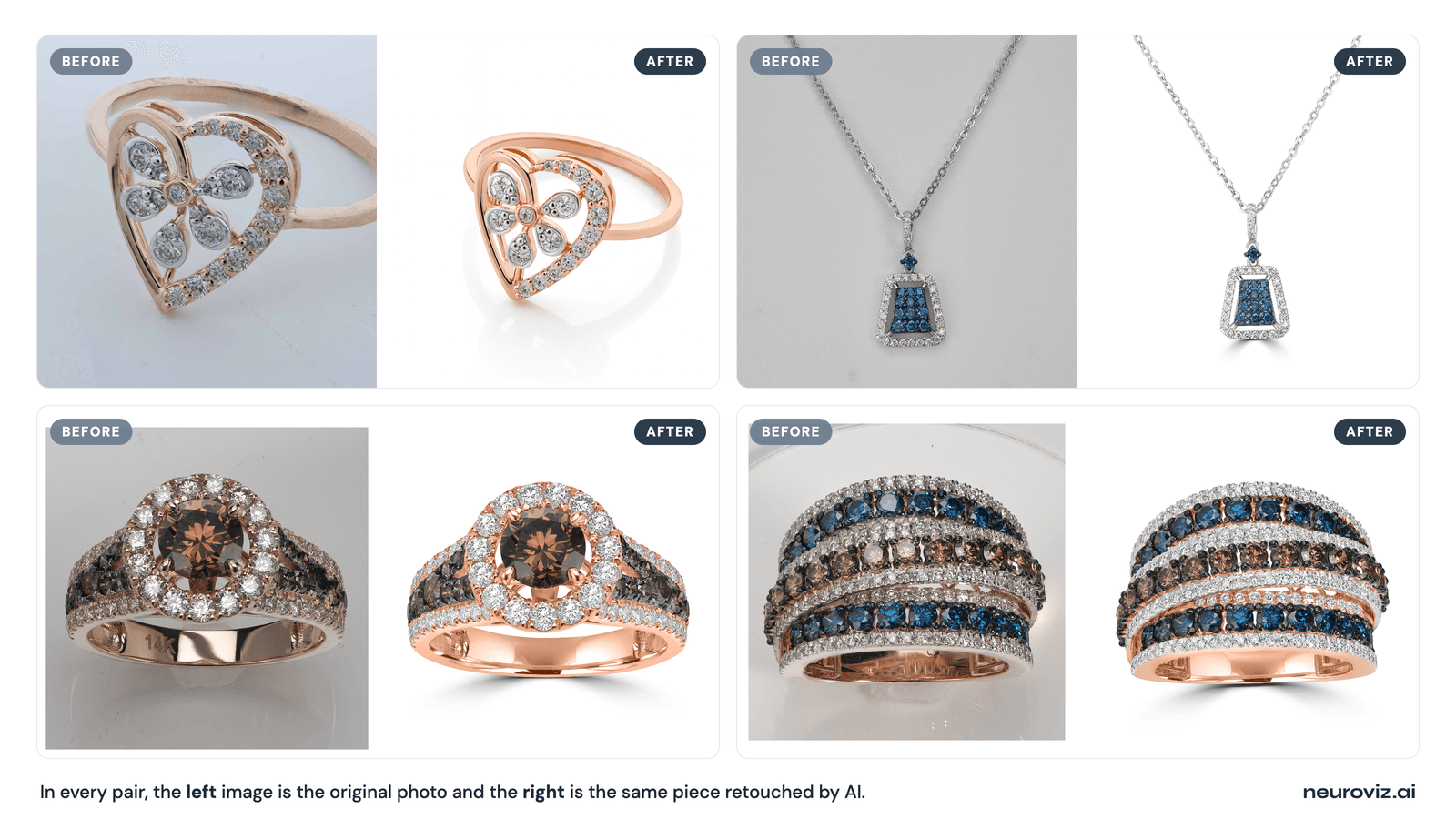
- Clean marketplace catalog shots (white background, single ring/earring/necklace) — NeuroViz AI jewelry retoucher handles these at studio quality. Trained on 50,000+ jewelry images, the model understands metals, prongs, gemstone facets, and reflections.
- On-model jewelry shots — jewelry virtual try-on puts your earrings, necklace, ring, watch, or bracelet on a generated model in seconds. No model day rates, no scheduling.
- Lifestyle and creative scenes — creative AI jewelry photography generates branded environments (marble, velvet, sand, neon) that would cost $200+ to shoot.
- A/B variants — generate 10 background variants in 5 minutes. Studio can’t compete here at any price.
- Color-accurate gold and silver tones — modern jewelry-trained AI renders metal warmth correctly, which generic AI editors still get wrong.
Where traditional studio still wins
This is the ai jewelry photography quality ceiling, and it’s narrower than people think — but real:
- Hero brand campaigns and editorial work. When the photograph itself is the message (Vogue spread, awards entry, billboard, packaging hero), a top studio with a Phase One back and a real retoucher still produces a different feeling than AI. AI is improving fast, but campaign-level work justifies the cost.
- Ultra-complex pieces — multi-stone pavé work with 80+ stones, deeply engraved antique pieces, or sculptural high jewelry where every facet matters. AI sometimes simplifies micro-detail. A skilled macro photographer plus retoucher will outperform AI here.
- Reflective and complex-geometry items in specific lighting setups. Mirror-polished cuffs and certain diamond cuts (rose, baguette in odd arrangements) can produce reflection artifacts in any AI workflow. Worth shooting these traditionally and retouching with AI rather than full-generating.
- Verification photography for high-value sales — certified loose stones, auction-grade pieces, GIA submission photos. For provenance and forensic accuracy, traditional macro photography is the standard.
- Brand stories and behind-the-scenes content that needs to feel candid and human.
The right answer for most jewelry brands is hybrid: studio for 5–10 hero shots a year, AI for everything else.
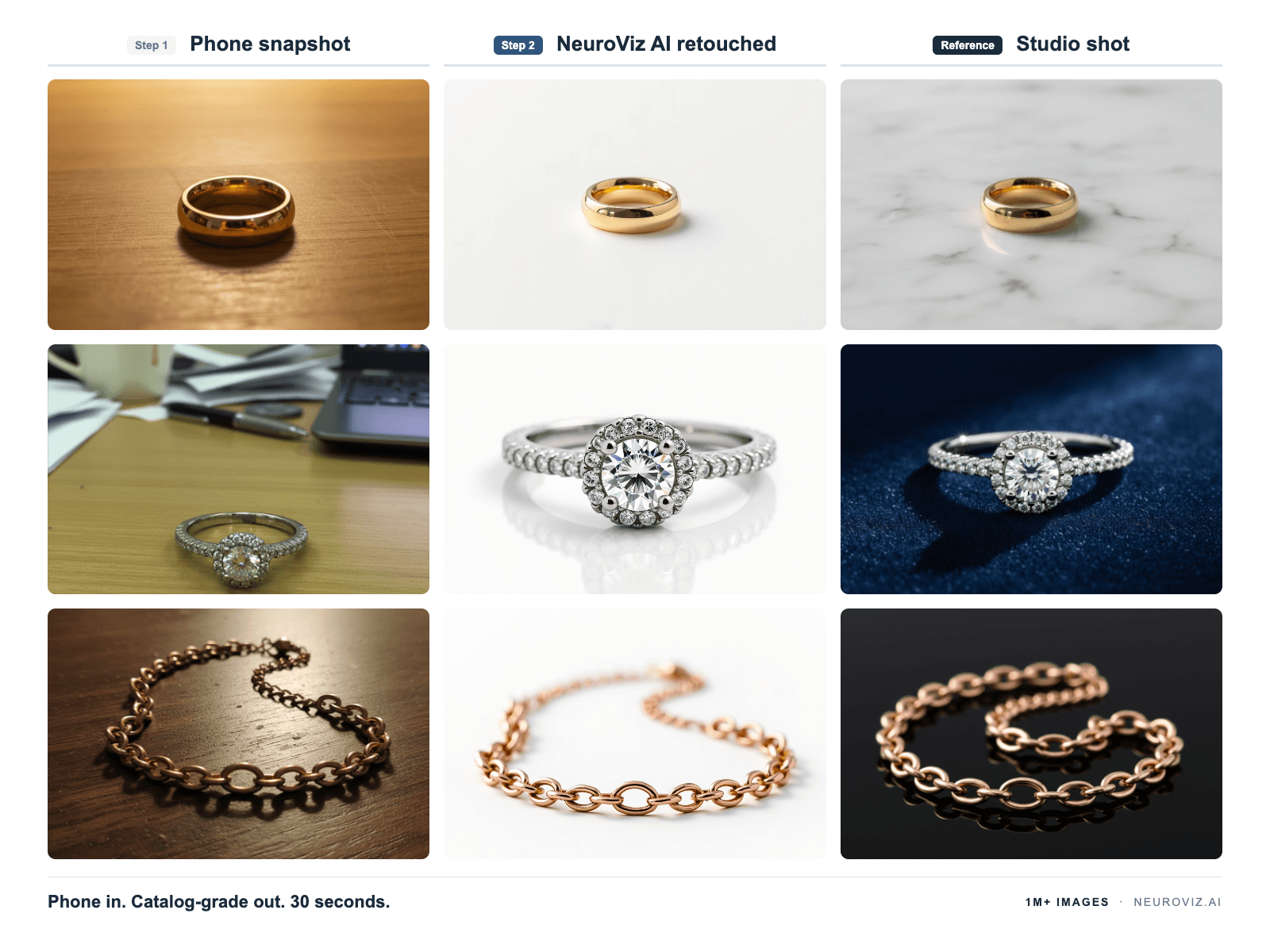
Three rows by three columns grid: phone snapshot → NeuroViz AI retouched → studio shot, for a gold wedding band, a pavé halo engagement ring, and a rose-gold link bracelet
Scalability: The Axis Studios Can’t Win
Studio cost scales linearly and burns calendar time. AI cost scales linearly but burns no calendar time. That’s the structural advantage.
Watch what happens at three catalog sizes (NeuroViz examples at the $200 pay-as-you-go rate, using 20-credit operations):
| Catalog size | Traditional studio (mid-tier, $35/image) | NeuroViz AI (~$0.50/image) | Savings |
|---|---|---|---|
| 100 SKUs (1 angle) | $3,500 + ~1 week | ~$50 + ~1 hour | $3,450 (98.6%) |
| 500 SKUs (1 angle) | $17,500 + ~3 weeks | ~$250 + ~half a day | $17,250 (98.6%) |
| 1,000 SKUs (1 angle) | $35,000 + ~5–8 weeks | ~$500 + 1 day | $34,500 (98.6%) |
| 200 SKUs × 3 angles + on-model + lifestyle | ~$50,000+ + 4–8 weeks | ~$300 + 1 afternoon | ~$49,700 (99.4%) |
The 90% savings claim from the headline is actually conservative — at scale you’re at 98–99% savings. On the $1,000 pay-as-you-go purchase ($0.018/credit) the AI column drops by another ~30%.
Iteration and Revisions
Traditional studio: every revision is a re-shoot or paid retouch round. Lead time is days. Budget overruns on revisions are a top complaint from jewelry brands.
AI: revise instantly. Don’t like the background? Regenerate. Wrong model demographic for your audience? Switch. Want to test silver chain vs gold? Run both, A/B them on your listing. With NeuroViz AI product photography tools, iteration is a function call, not a project.
This compounds. Brands that iterate quickly on listing photos tend to outperform on Etsy, Amazon, and Shopify because they treat their catalog like a living asset, not a fixed deliverable.
Skill Requirement
Studio path needs: photographer, stylist, retoucher, sometimes a model and a producer.
AI path needs: a clear phone photo of the piece. NeuroViz handles lighting, background, retouching, models, and scenes. The tradeoff: you trade craft control for accessibility. For 95% of independent jewelers, Etsy shops, and growing brands, that’s the right trade.
Studio vs AI Photography — At-a-Glance Comparison
This is the studio vs ai photography summary if you only have 30 seconds:
| Axis | Traditional Studio | NeuroViz AI |
|---|---|---|
| Cost per image | $25–$100+ | $0.09–$3.20 (typical $0.50) |
| Turnaround per image | 0.5–4 days (incl. shipping) | ~30 seconds |
| Quality (catalog) | Excellent | Excellent |
| Quality (hero/editorial) | Excellent | Good, improving |
| Quality (complex pavé / micro-detail) | Excellent | Variable — sometimes simplifies |
| Scalability | Linear cost + calendar | Linear cost, no calendar |
| Revisions | Days, paid | Seconds, included |
| Skill required | Photographer + retoucher + stylist | Phone + credit pack |
| On-model / try-on shots | $200+ model day rate, scheduling | ~$0.50 per try-on, instant |
| Variants and A/B testing | Cost-prohibitive | Trivial |
| Best for | Hero campaigns, editorial, certification | Catalog, marketplaces, social, video |
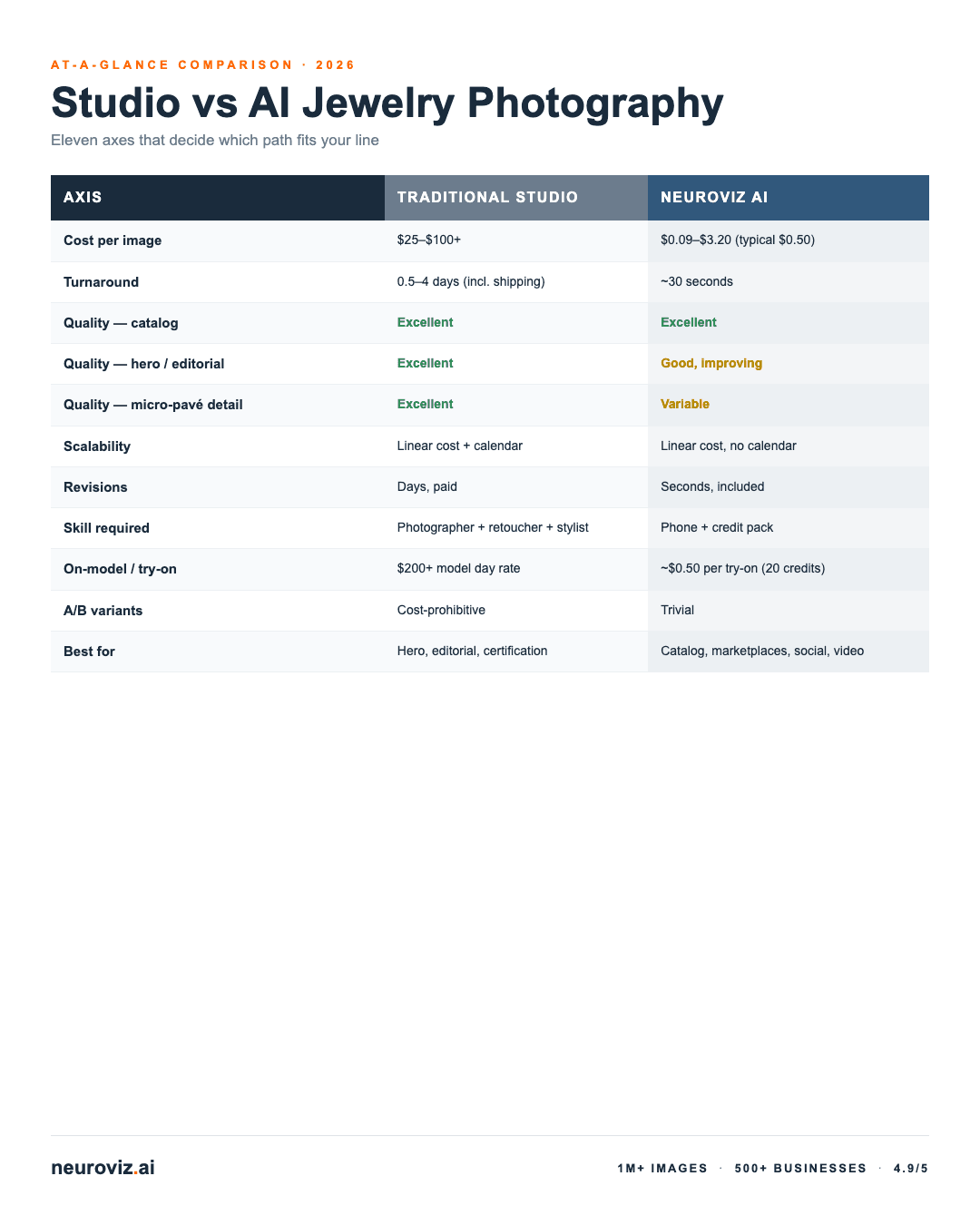
Branded eleven-row comparison table: Traditional Studio vs NeuroViz AI on cost, turnaround, quality at three tiers, scalability, revisions, skill, on-model, A/B variants, and best-for use cases
Worked Example: An Etsy Seller With 200 SKUs
Real scenario — a handmade jewelry seller on Etsy with a 200-piece catalog, planning a 2026 refresh. Each piece needs one clean catalog photo, one on-model shot, and one lifestyle shot. That’s 600 finished images.
Traditional path:
- Ship 200 pieces to studio (insured, both ways): ~$400
- Catalog photography, mid-tier rate $35/image × 600: $21,000
- Model day for on-model shots (2 days at $1,500): $3,000
- Lifestyle styling and props: $1,500
- Two revision rounds: $2,000
- Total: ~$27,900 | Calendar time: 6–8 weeks
NeuroViz AI path ($200 pay-as-you-go purchase: $0.025/credit):
- Take 200 phone photos of pieces on white paper at home: half a day
- Run NeuroViz AI Jewelry Retoucher on all 200 (20 credits × 200 = 4,000 credits × $0.025): $100
- Run jewelry virtual try-on for on-model shots (20 credits × 200 = 4,000 credits): $100
- Run creative jewelry photography for lifestyle scenes (20 credits × 200 = 4,000 credits): $100
- Total: ~$300 plus a phone afternoon | Calendar time: 1 day
On the $1,000 pay-as-you-go purchase ($0.018/credit) the same job is ~$216. With a $10 pay-as-you-go purchase ($0.04/credit) it’s ~$480 — still 58× cheaper than studio.
Same 600-image catalog. $27,900 vs $300. Eight weeks vs one day. 93× cheaper. Even if the seller spends an afternoon re-running 20% of the AI outputs for better composition, the math doesn’t move meaningfully.
That gap is what 500+ businesses on NeuroViz have already chosen.
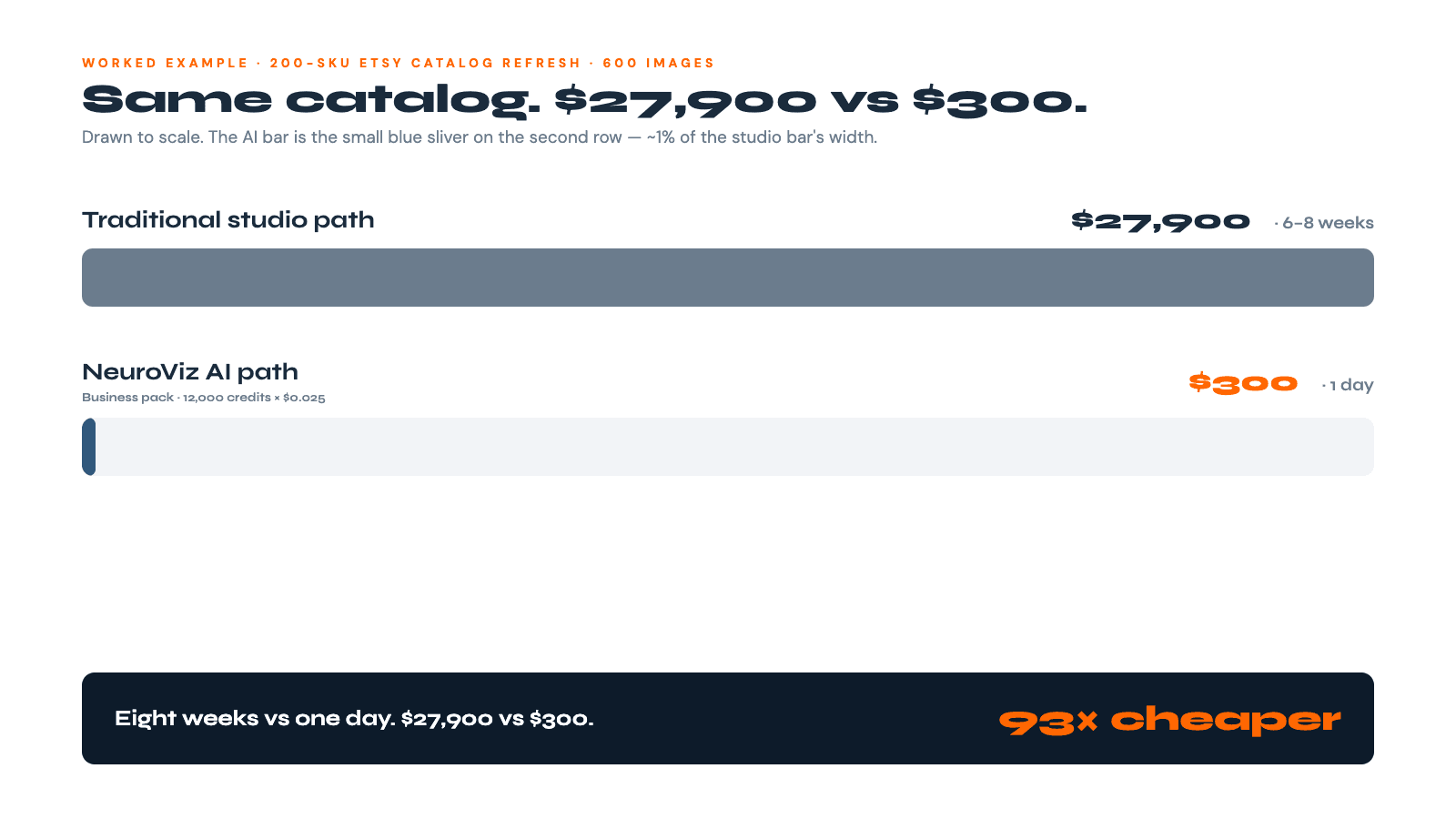
Two horizontal bars to scale: traditional studio path $27,900 over 6–8 weeks fills the full width, NeuroViz AI path $300 in 1 day is a small sliver — 93× cheaper
When Traditional Studio Photography Is Still the Right Call
To stay honest — and because the answer to is ai photography good enough for jewelry depends on what you’re shooting — here’s when we tell prospects to book a studio instead of (or alongside) NeuroViz:
- You’re shooting a campaign hero or magazine submission. The single image that anchors your brand for the year. Pay the studio. Then use AI for everything around it.
- Your piece is one-of-one, $50K+, and the photo will be used for sale provenance. Buyers at that price point expect macro photography and certified imaging. Use AI for the marketing variants after the hero exists.
- The piece has hyper-fine micro-detail (intricate filigree, pavé with 100+ tiny stones, deeply engraved antique work) where every facet must be readable at print resolution. Hybrid is best here — shoot once, then use AI to generate background variants, model shots, and lifestyle scenes from that hero.
- You’re submitting for awards or competitions (Couture, JCK Jewelers’ Choice). Judges expect studio work.
- You’re shooting brand-story content that needs human authenticity — bench shots, the maker at work, candid lookbook moments. AI can support these but shouldn’t replace them.
For the other 95% of jewelry photography — catalog, marketplaces, social, ads, video thumbnails, on-model variants, lifestyle scenes — AI is now the right tool. That’s not opinion; it’s what the 1M+ images and 4.9/5 rating trend across our user base shows.
Frequently Asked Questions
Can AI replace a real jewelry photographer?
For catalog, marketplace, and social images — yes, increasingly. For hero campaigns, editorial work, and certified high-value pieces, no. The realistic 2026 answer is hybrid: AI for volume, photographer for the 5–10 hero shots that anchor your brand.
Is AI photography good enough for luxury jewelry?
For luxury catalog and marketplace listings — yes, with a jewelry-specialized tool. NeuroViz is trained only on jewelry, so it renders gold tones, gemstone facets, and prong work correctly where generic AI editors fail. For luxury campaign and editorial work, top studios still produce a different quality of image. Many luxury houses now run hybrid pipelines.
How does AI handle diamonds, gemstones, and reflective surfaces?
A jewelry-trained AI like NeuroViz handles standard diamond cuts, faceted gemstones, and most polished metals well — this is the core of what it was trained on. Edge cases (mirror-polished cuffs, rose-cut diamonds in unusual arrangements, certain enamel finishes) can still produce artifacts and are worth shooting traditionally first. The retoucher then cleans those raw shots.
Will Amazon, Etsy, and Shopify accept AI-generated images?
Yes — all three marketplaces allow AI-edited and AI-generated product images, with platform-specific guidelines around accurate representation. Amazon’s white-background and image-quality requirements are met by NeuroViz output. Etsy and Shopify have no restrictions on AI imagery for product listings as long as the image accurately represents what the buyer receives. Always ensure the AI image matches the physical product (no added stones, materials, or details that aren’t there).
How much does jewelry photography cost in 2026?
Three tiers: traditional studio runs $25–$100/image (more for hero/editorial), DIY-with-Photoshop runs $3–$8/image effective when you cost your time, and AI runs $0.09–$3.20/image with NeuroViz — typically ~$0.50 on the popular $200 pay-as-you-go purchase. NeuroViz is credit-based: an image takes 5–80 credits depending on quality/resolution, and pay-as-you-go credits cost about $0.018–$0.04 each depending on purchase size. Monthly and annual subscriptions offer separate rates with Pro Membership included. Most growing brands now run a hybrid stack: a few hundred dollars/year on AI credits replaces $10,000–$30,000 on studio for catalog work.
When should I still use a traditional studio?
Five clear cases: (1) campaign hero or magazine submission, (2) certified high-value sale photography ($50K+ pieces), (3) ultra-complex pavé or filigree work where micro-detail matters, (4) awards and competition submissions, (5) human brand-story content. Everything else — catalog, social, marketplace, model shots, lifestyle — is faster and cheaper through AI.
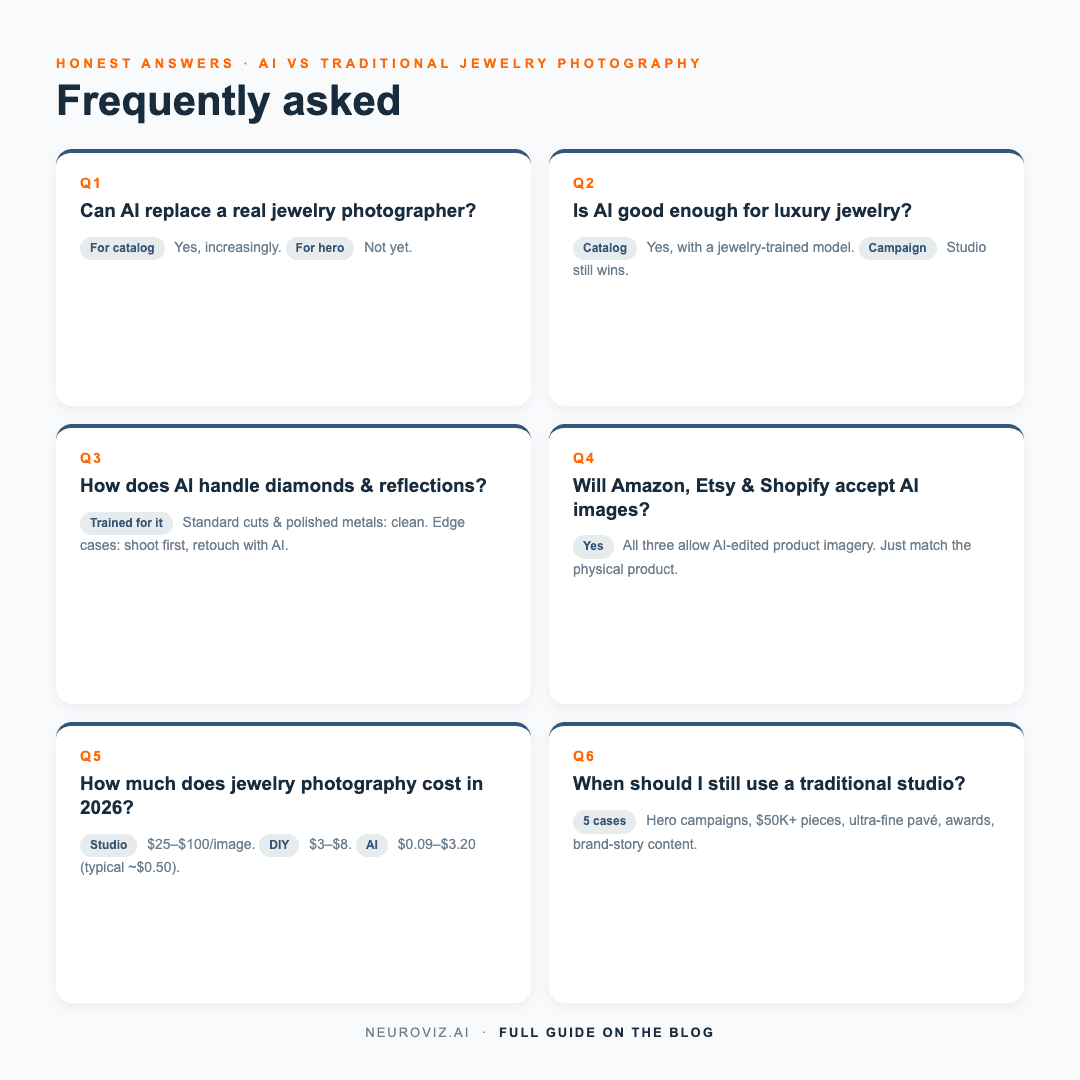
Pinterest-friendly FAQ card showing six bubble-style answers: AI replace photographer, luxury jewelry quality, diamonds and reflections, marketplace acceptance, cost in 2026, when traditional studio still wins
Start With 80 Free Credits — Test It on Your Catalog
The fastest way to settle the ai vs traditional jewelry photography question for your line is to run 10 of your own pieces through both paths and compare. Get the studio quote, then test NeuroViz free.
- Free trial: 80 credits, no credit card. Enough for ~4 standard 20-credit operations or ~16 simpler 5-credit operations.
- $50 → 1,500 credits ($0.033/credit) — enough for a small catalog refresh.
- $200 → 8,000 credits ($0.025/credit) — most popular for active sellers. Typical image lands around $0.50.
- $1,000 → 55,555 credits ($0.018/credit) — a pay-as-you-go option for high-volume catalog teams. Typical image at ~$0.36.
- Pro Membership: optional $29/month with pay-as-you-go, with no credits included. Adds batch processing, API access, Smart Retry at one-third credit cost, and no expiry on purchased credits while active. Every subscription includes Pro.
Operations are sized by quality: simple retouches start at 5 credits (~$0.09–$0.20/image), standard try-on and creative shots use 20 credits (~$0.36–$0.80/image), and hero/max-resolution outputs use 40–80 credits (~$0.72–$3.20/image). Video credit costs vary by tool, duration and resolution; check the quote before generating.