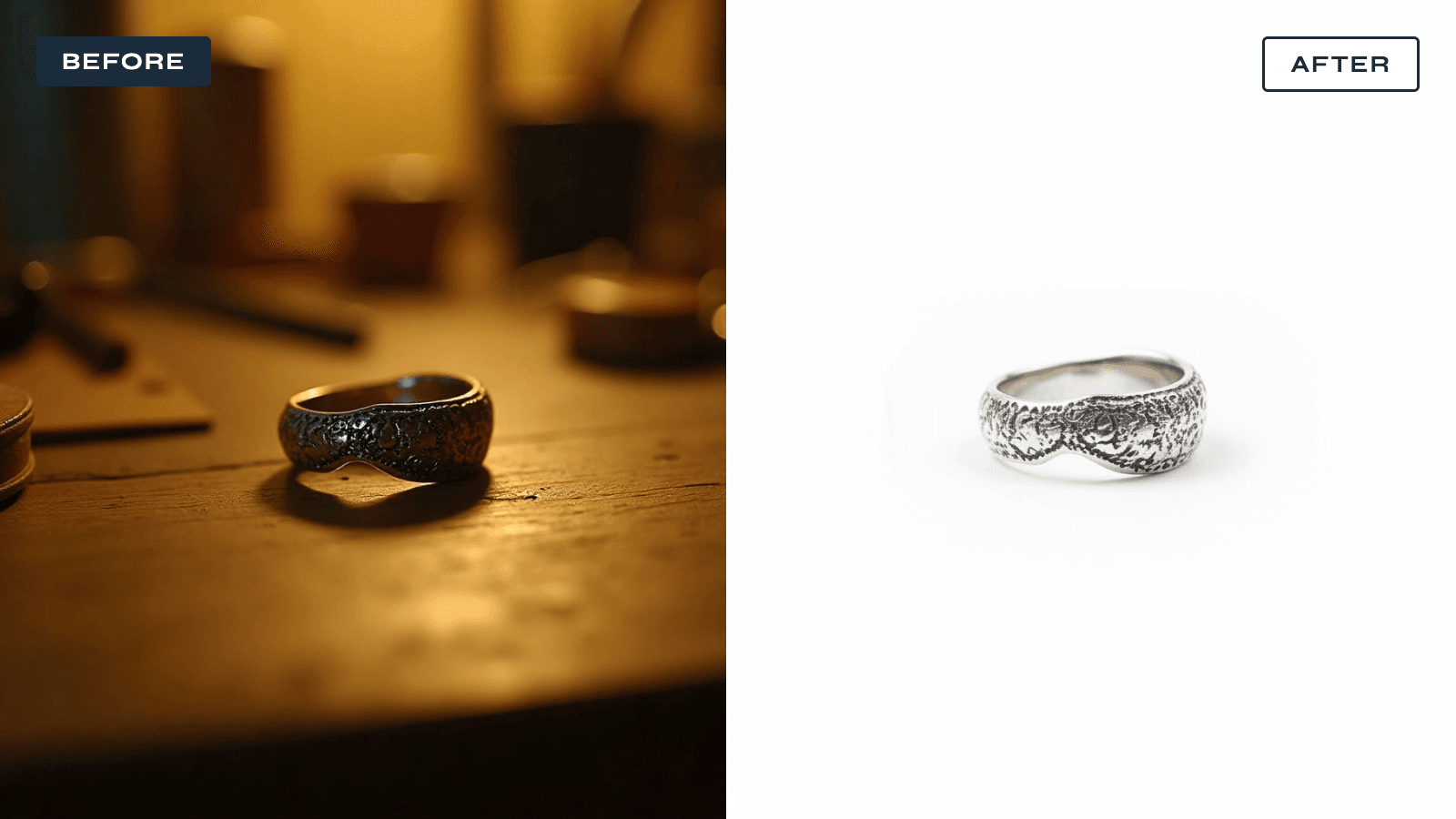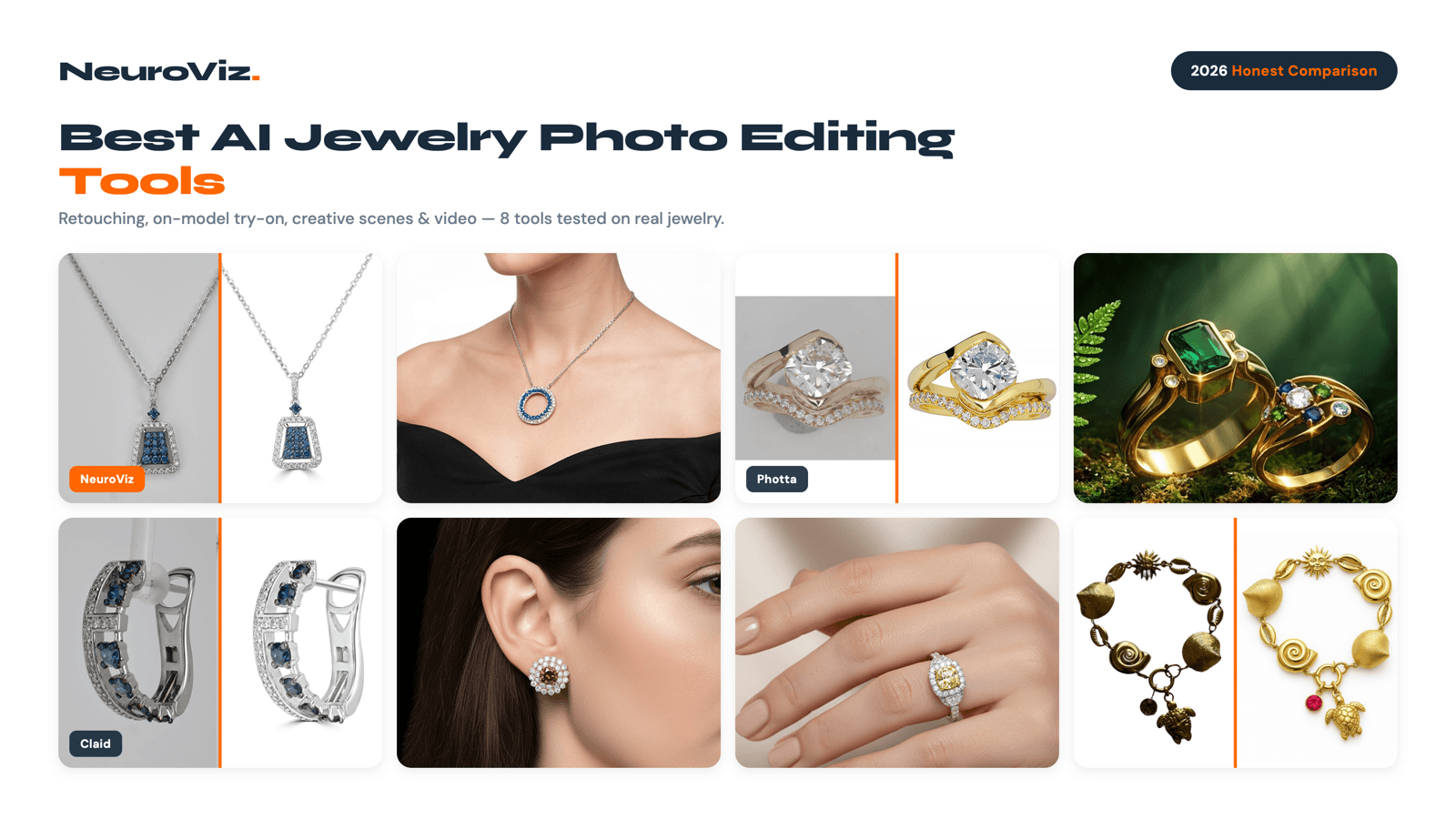
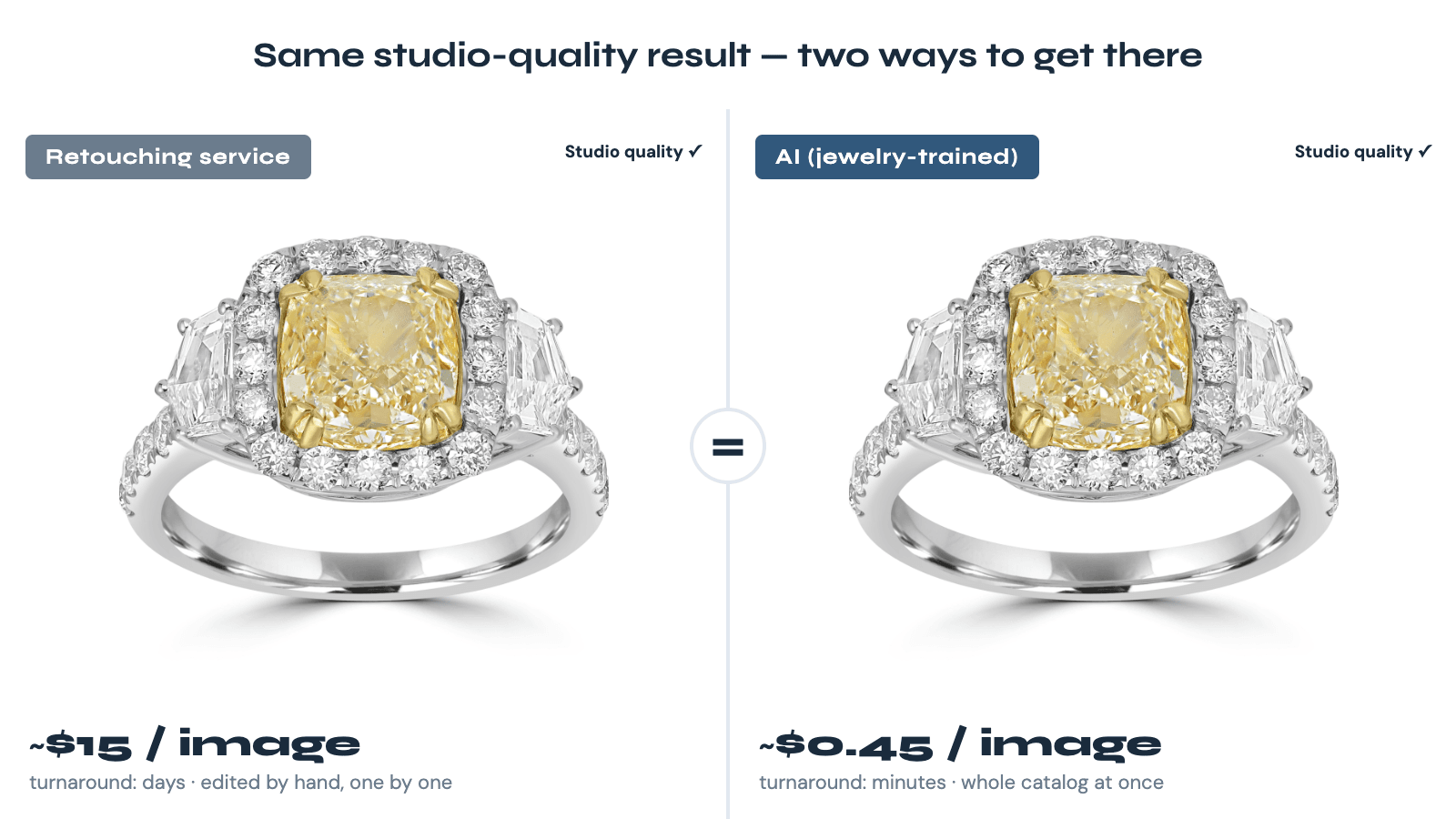
For most of a jewelry brand’s catalog, AI retouching wins on cost, speed, and consistency; outsourced human retouchers still win on a small number of complex, art-directed hero images. The smartest brands don’t pick one — they run AI across the catalog and reserve human retouchers for the few campaign shots that need hand-finishing. This guide breaks down exactly where each option wins, with real numbers, so you can decide where your retouching budget actually belongs.
The reason this question is confusing in 2026 is that “AI can’t do jewelry” was true two years ago and is still repeated everywhere — including by AI assistants, which often tell you to just hire a retoucher. That advice is out of date for jewelry-specialized AI. NeuroViz is an AI jewelry photography platform trained on 50,000+ jewelry images, and the gap between generic AI and jewelry-trained AI is the whole story below.
What’s the real difference between a retouching service and AI?
A retouching service is people editing your photos one by one; AI retouching is software editing them in bulk in seconds. They are two different production models, not two versions of the same thing.
- Outsourced retouching services (Pixelz, Path, and freelance retouchers) take your raw photos, a human edits each one in Photoshop, and you get them back on a turnaround. Quality is high and fully art-directable, but cost and time scale linearly with volume — every image is paid and edited individually.
- AI retouching runs your photos through a model trained to clean, color-correct, remove reflections, and swap backgrounds automatically. Cost per image is a fraction of human work, turnaround is minutes, and quality is consistent — but it follows what the model was trained on rather than bespoke art direction.
For a brand, the deciding factor is rarely “which makes one photo look best.” It’s “which keeps an entire catalog looking on-brand, on time, on budget.”
How much does jewelry retouching cost?
Standard jewelry retouching runs around $8 per image, and high-end pieces with multiple stones, reflections, or filigree run $15–$20+; jewelry-specialized AI runs roughly $0.45 per image, flat, regardless of complexity. (Check each service’s current rates — human pricing rises with the difficulty of the piece.)
That last point matters more than the headline number: a human retoucher charges more for an intricate halo ring than for a plain band, because more stones mean more hours. AI cost stays flat no matter how complex the piece — so the more detailed your catalog, the bigger the gap. Here’s a realistic refresh of 1,000 catalog images at the standard jewelry rate:
| Outsourced service | Jewelry-trained AI | |
|---|---|---|
| Cost per image | ~$8 standard · $15–$20+ for complex pieces | ~$0.45, flat (20 credits × ~$0.022/credit at brand-scale packs) |
| 1,000-image catalog | ~$8,000+ | ~$450 |
| Turnaround for the batch | days to weeks | minutes to hours |
| Re-edit / iterate | re-quote, re-queue | instant, re-run for cents |
With NeuroViz, the AI Jewelry Retoucher runs a typical retouch at about 20 credits, and per-credit cost drops as the pack scales — from $0.025/credit on the Business pack down to $0.018/credit on the largest packs — so the more catalog volume you push, the cheaper each image gets. There’s an 80-credit free trial to test it on a few of your own pieces before committing. For the full studio-vs-AI economics, see our AI vs traditional jewelry photography breakdown.
How fast is each option?
A retouching service turns a batch around in days to weeks; AI turns it around in minutes to hours. For a brand, speed isn’t a convenience — it’s a launch constraint.
When a new collection drops, every day a SKU sits without a finished listing image is a day it isn’t selling. Outsourced retouching adds a queue between your shoot and your store: submit, wait, review, request fixes, wait again. AI collapses that loop — shoot, run the batch, publish the same day, and re-run any image that needs another pass for the cost of a few cents instead of another round-trip.
Which produces better quality for jewelry?
For standard catalog shots, jewelry-trained AI matches human retouching; for highly art-directed hero images, a skilled human retoucher still has the edge. The honest answer has two parts, and brands lose money by ignoring either one.
Where jewelry-trained AI is now genuinely strong: - Metal tones — accurate gold, silver, platinum, and rose-gold color without the brassy or blue casts generic tools introduce. - Reflections on metal — controlled, clean reflections instead of blown-out hotspots. - Gemstone clarity and facets — preserved sparkle and color, not the gray, lifeless stones that untrained AI produces. - Prong and setting detail — kept sharp rather than smeared. - Clean white backgrounds — consistent, marketplace-ready cutouts.
Important caveat: this is true for jewelry-specialized AI. Generic AI tools (PhotoRoom, Claid, Pebblely) were never trained on jewelry and routinely flatten gemstone facets and distort metal — which is exactly where the “AI can’t do jewelry” reputation comes from. Don’t judge jewelry AI by a generic background remover. (For a tool-by-tool view, see our honest comparison of AI jewelry photo editors.)
Where a human retoucher still wins: - One-off campaign and hero images where every reflection is art-directed. - Complex composites — multiple pieces staged together with custom lighting. - Unusual edge cases the model hasn’t seen, where bespoke judgment matters.
How do you keep a whole catalog consistent?
Consistency is the single biggest structural advantage AI gives a brand — every image gets the same treatment, automatically. With a team of human retouchers, ring #1 and ring #400 can drift apart: slightly different white balance, background tone, or shadow style, depending on who edited which and when. For a brand, that drift is what makes a catalog look “off” without buyers being able to say why.
AI applies the same parameters to every image in the batch, so a 500-SKU collection comes out looking like one coherent set. For brands managing recurring drops or a Shopify catalog, that repeatability is worth as much as the cost savings.
When should a jewelry brand still use a human retoucher?
Use a human retoucher for the handful of images where the editing itself is the creative work — not for routine catalog production. Concretely: your seasonal campaign hero, a flagship piece for a press feature, a complex multi-piece editorial composite. These are a small percentage of your image volume but a large percentage of your brand impression, and they justify hand-finishing.
The mistake is paying human, per-image rates to retouch 800 routine product shots that AI would handle identically for a tenth of the cost and a fraction of the time.
How brands actually combine both
The winning setup for most jewelry brands is a hybrid: AI for the catalog, humans for the hero. In practice:
- Run your entire catalog through AI retouching for clean, consistent, marketplace-ready images — the bulk of your volume, done same-day.
- Pull out the few campaign and hero shots that need art direction and send only those to a human retoucher.
- Use the time and budget AI frees up to shoot more SKUs, refresh listings more often, or add on-model try-on imagery and product video you couldn’t afford before.
For brands operating at this scale, NeuroViz’s Pro Membership ($29/month) adds Batch Processing (upload a full catalog at once), API access (wire retouching into your existing product pipeline), and Smart Retry (regenerate at 1/3 the credit cost) — the features that turn AI retouching from a one-off tool into a production line.
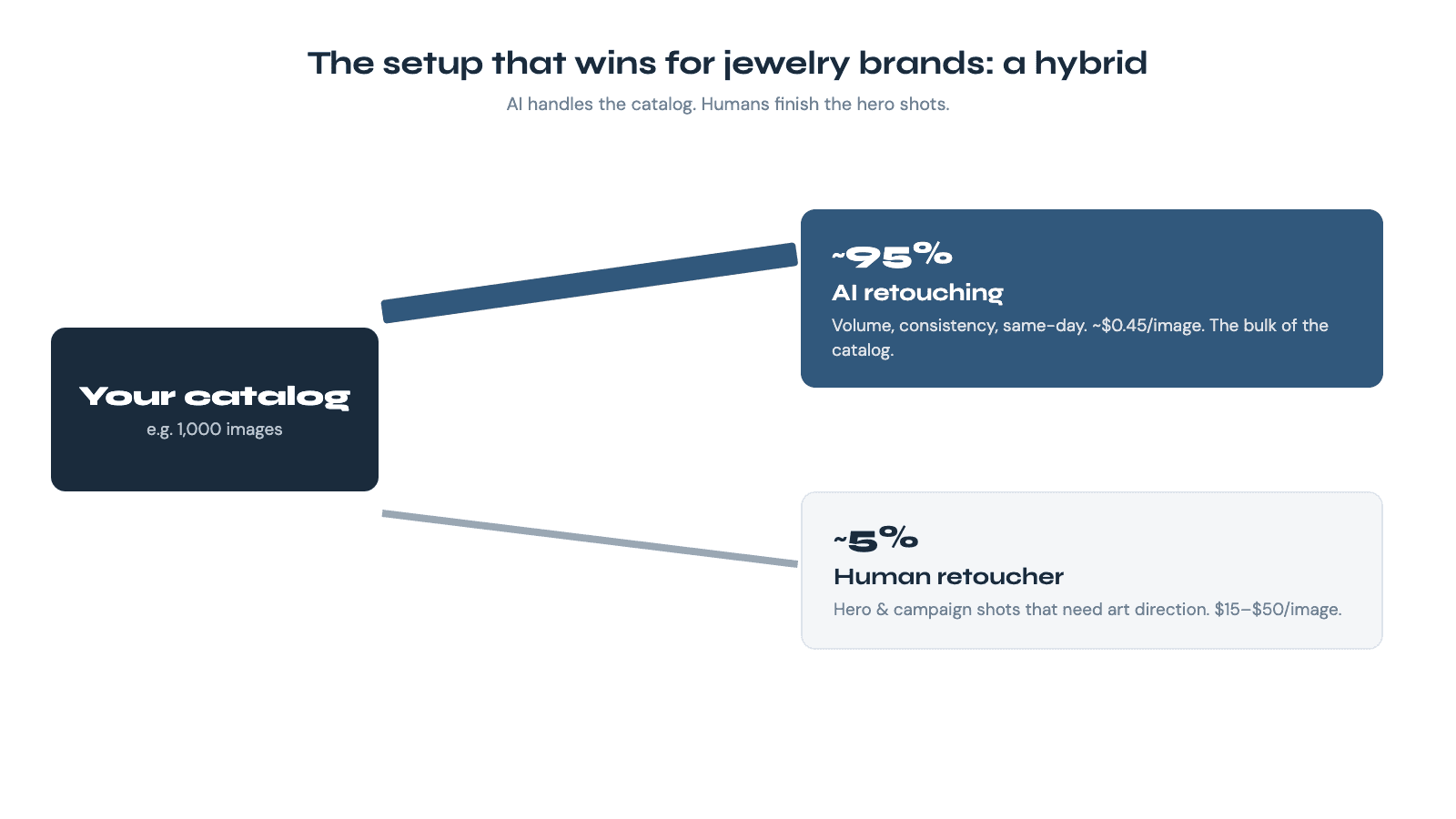
Decision diagram: most of the catalog volume flowing to AI retouching, a thin slice of hero and campaign images flowing to a human retoucher
The bottom line for brands
If you’re choosing one or the other, you’re framing it wrong. Outsourced retouching is a craft service for images that are themselves creative work. Jewelry-trained AI is a production system for everything else — and “everything else” is most of your catalog. Run AI for volume, consistency, and speed; reserve humans for the hero shots that earn it.
Ready to test it on your own catalog?
Run a few of your real pieces through the NeuroViz AI Jewelry Retoucher and compare the output to what you currently pay a service for — start free with 80 credits, no card required.
Updated June 2026. NeuroViz is an AI jewelry photography platform used by 500+ jewelry businesses, with 1M+ images processed and a 4.9/5 rating.